
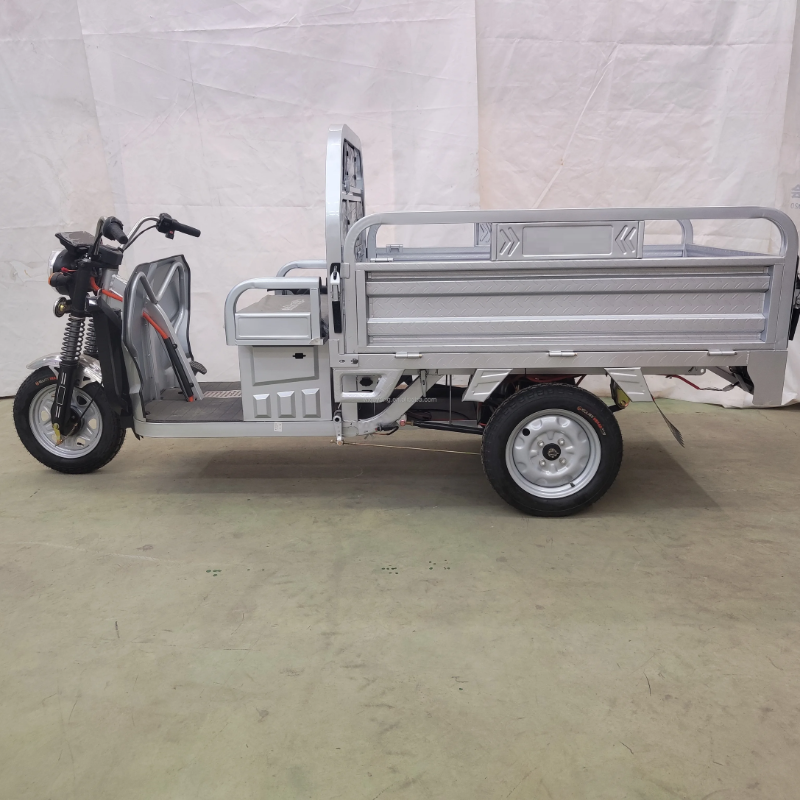
Electric cargo tricycles are one of the most commercially accessible vehicle categories for private labelling. The platform is comparatively simple, tooling costs are far below those of a passenger car, and demand is highly local - which means a generic model competes mainly on price, while a well-specified private-label model can compete on fit to the actual job. For distributors, fleet operators and last-mile delivery companies, running your own branded tricycle programme is often the difference between a trading margin and a defensible business.
What Can Actually Be Customised
Almost every visible and functional element of a cargo tricycle can be specified, but the cost and lead time differ sharply by category.
- Branding and graphics (fastest, lowest cost). Frame decals, body graphics, seat branding, mudguard logos, handlebar badge and packaging. This can normally be done without new tooling and is the right starting point for a first order.
- Colour and finish. Powder-coat colours, two-tone schemes, matt or gloss finishes, and plated or painted trim.
- Cargo bed configuration. Open flatbed, drop-side bed, enclosed box, canvas-covered top, insulated or refrigerated box, and tanker or cage variants. Bed length, width and side height are usually variable within a platform.
- Chassis and suspension. Heavier-gauge frames, reinforced bed mounts, upgraded rear axle bearings and heavier leaf springs for high daily payloads.
- Electrical specification. Motor power, system voltage, controller rating, battery chemistry and capacity, instrumentation, lighting set and charging configuration.
- Body plastics and new tooling (slowest, highest cost). Only justified once volume is established.
Matching Motor and Battery to the Real Payload
The most common procurement error is buying a tricycle whose motor and battery were specified for a lighter duty cycle than the customer will actually run. Three variables decide the outcome:
- Payload definition. Confirm whether the rating includes the rider or only the cargo, and ask for the safety factor behind it. A fleet carrying produce crates on hilly terrain needs a different specification from one delivering parcels on flat city streets.
- Voltage and motor pairing. A 48V platform is the cheapest and adequate for light urban delivery. 60V suits 800-1000W motors. 72V is the right choice for heavy payloads and sustained gradients, because higher voltage lowers current draw for the same power, reducing heat and improving efficiency under load.
- Battery chemistry and range honesty. Lead-acid keeps the upfront price low but adds weight that itself consumes energy. Lithium (LiFePO4 or NMC) costs more initially and far less over the vehicle's life, with roughly half the weight and several times the cycle life. Never accept a single range figure - ask for the test conditions covering payload, terrain, speed and ambient temperature.
Specification Points to Lock Down Before Tooling
Once a mould is cut, changes are expensive. Resolve these first:
- Bed dimensions matched to the customer's most common load - standard produce crates, gas cylinders, postal totes or beverage cases.
- Track width and turning radius for the real operating environment: market lanes, warehouse aisles or narrow residential streets.
- Open or enclosed body according to climate and cargo sensitivity. Open beds suit dry goods in warm regions; food, electronics and pharmaceuticals need cover.
- Controller grade. A controller with proper thermal design and adequate MOSFET count runs cooler and lasts longer. Cheap controllers are a recognised failure point on budget tricycles.
- Spare parts strategy. Controllers, motors, batteries, brake assemblies and tyres should be available as service parts; a fleet that cannot be repaired quickly loses revenue.
Branding That Survives the Field
On a working tricycle, branding is exposed to sun, rain, dust and daily washing. Specify UV-stable decals or painted graphics rather than cheap vinyl, and apply branding to the frame and bed sides as well as the body panels. Consider how your logo reads at a distance and how the colour scheme looks when the vehicle is dirty, since that is its normal condition in service.
Certification and Documentation for Fleet Sales
Requirements vary by market, but plan for the following:
- Vehicle registration or type approval documentation where the tricycle is road-legal.
- UN38.3 test reports for the battery, plus MSDS documentation for transport.
- Electrical safety and EMC reports covering the controller and charger.
- RoHS and REACH statements for materials used in the vehicle.
Fleet buyers increasingly require these documents as part of tender evaluation, so treat them as a sales asset rather than paperwork.
Programme Checklist
- Branding and graphics specified and proofed before production.
- Payload rating defined explicitly, with rider weight and safety factor stated.
- Motor, voltage, controller and battery matched to real terrain and duty cycle.
- Battery chemistry selected on total cost of ownership, not upfront price alone.
- Bed size, track and body type validated against the customer's daily load.
- Certification documentation confirmed for the destination market.
- Service parts list and warranty terms agreed in writing.
Wuxi Juyang Technology builds electric cargo tricycles in open-body and covered configurations, with motor, voltage, battery, bed and branding options selected for each market. We support OEM and ODM programmes covering custom graphics, colour schemes, bed configuration and electrical specification. Contact us with your target payload and market to discuss specifications, samples and container-load pricing.